When the Body Asked Me to Stop
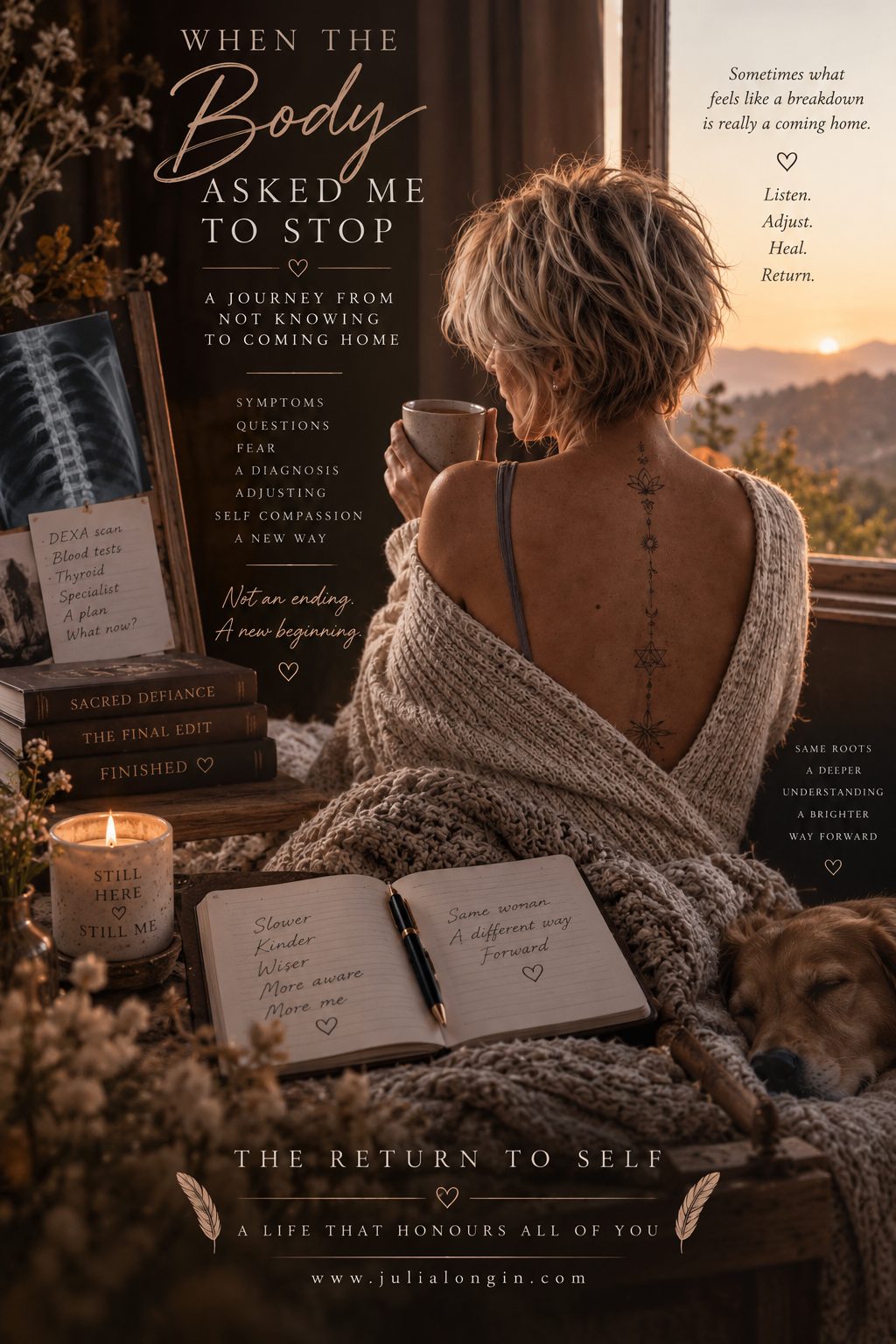
For a long time, I didn't know what was happening to my body. I knew something wasn't right. I knew I was tired in a way that sleep didn't seem to fix. But not knowing is its own kind of discomfort.
Then an ordinary chest X-ray changed everything. There were compression fractures through my thoracic spine, with kyphosis and multiple areas of damage. Suddenly something that had felt vague had a name.
A diagnosis can be confronting, but there was also something strangely comforting about finally knowing. I wasn't imagining it. My body had been trying to tell me something.
My DEXA showed low-normal bone density, only 0.10% over the limit for osteopenia. That didn't neatly explain what had happened. There were several pieces to the puzzle, but no simple answer.
But the diagnosis brought another question with it, one that was much harder for me to answer. What happens when you are someone who has always done, and suddenly you can't?
I didn't struggle so much with the fractures themselves as I did with the limitations. There is a particular kind of grief in discovering that your body has boundaries you haven't been listening to.
My first instinct was to fight the limitation. But slowly, something began to change. I started to understand that accepting a limitation wasn't the same as giving up. It was learning to listen.
Because paying attention meant acknowledging just how long I had been overriding myself. Tired? Keep going. Hurting? Push through. Need help? I'll manage. My body had been speaking to me for a very long time. I just wasn't listening.
And it wasn't only my body. My book had been speaking to me too. I had reached a point with Sacred Defiance where I thought I had finished. Then I slowed down enough to look at it again. And there it was. More to say.
So I went back through it. I sat with parts that were difficult. And eventually, I finished it. Not because I pushed harder. Because I finally slowed down enough to listen.
I had to reconsider my own beliefs about HRT during this process too. I had carried fears and assumptions for years, based on information that had been repeated so often it felt like fact. My doctor prescribed oestrogen as part of the plan to support my body, alongside vitamin D3 and K2.
What mattered to me was that I stopped making decisions from fear. I discovered something I think is going to stay with me for the rest of my life: listening to your body is not the opposite of being strong. It is part of being strong.
There is a delicate balance between trusting yourself and being willing to learn, and I think I am finally learning how to stand in that space.
The things that helped me come back to myself were not complicated. Movement. Nourishment. Rest. Reflection. Connection. Purpose. Stillness. And slowly, I began to see that there was a flow to them. Not a program. A way of living.
This is where Return to Self began. Not as an idea I sat down and invented. It grew out of what I was actually living. The Wheel holds the deeper exploration. The Seven Pillars were beginning to take shape as the things that support us while we are actually living that work.
I had spent years putting myself last and calling it strength. I don't think I was weak. I think I was disconnected. There is a difference.
I no longer see adjustment as failure. I see it as awareness. I am learning to stop going against myself. That is the beginning of Return to Self.
For me, it was my body. It was my book. It was my exhaustion. It was my life. They were all saying the same thing. Stop. Listen. Come back. And for the first time, I did.