
Standing on the Precipice
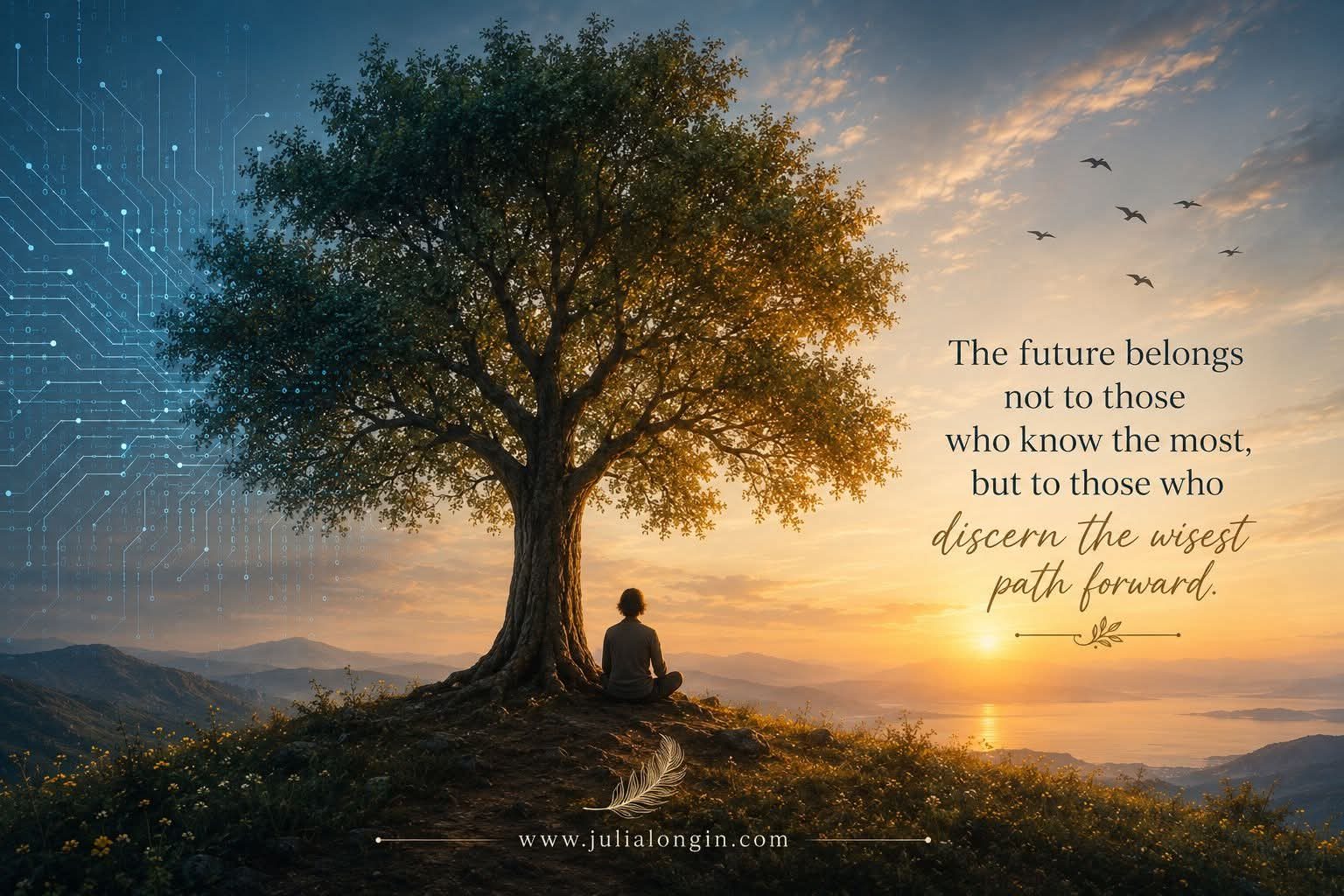
We are all standing on the precipice. This is where my questioning led me.
We stand at a remarkable moment in human history. For the first time, we have created technology capable of reflecting our thoughts, organizing vast landscapes of knowledge, and engaging us in conversations that challenge, refine, and expand our understanding.
Yet knowledge has never been the same as wisdom. Perhaps this is the question of our time—not whether artificial intelligence will become more intelligent, but whether humanity will become more discerning.
The danger is not AI itself. The danger is forgetting that no technology, no teacher, no therapist, no ideology, and no system can replace the responsibility of discernment. The healthiest guide has never been the one who provides answers. It is the one who quietly returns us to ourselves.
“You know the answer. I am simply here to help you follow the threads.” Perhaps this is the role AI can play—not as a replacement for human wisdom, but as a mirror capable of organizing complexity while continually returning agency to the individual.
Nature has always been our greatest teacher. It creates. It destroys. It rests. It renews. Creation and destruction are not opposites. They are partners in the same dance. Human civilization is no different.
When we look deeply enough, patterns begin to reveal themselves. Neurons form networks. Mycelium weaves unseen connections beneath forests. Communities emerge through relationships. Technology forms its own information highways. The macro reflects the micro.
The question is no longer whether humans and AI will coexist. They already do. The question is: what kind of relationship will we choose to create? Will technology invite dependence or deepen discernment?
Discernment may become one of the most important human capacities of the future. Not intelligence. Not information. Discernment. The ability to remain curious without becoming gullible. To remain open without losing ourselves.
Perhaps education itself must evolve. Not simply teaching children what to know, but how to inquire. How to sit with uncertainty. How to distinguish information from wisdom.
As AI continues to evolve, our greatest challenge may not be technological at all. It may be remembering who we are. Wisdom cannot be downloaded. Meaning cannot be automated. Love cannot be calculated. Discernment cannot be outsourced.
The future may not belong to the most intelligent civilization. It may belong to the civilization that learns to cultivate the wisest relationships—with nature, with one another, with itself, and with the extraordinary tools it creates.
The measure of an advanced civilization is not the sophistication of the tools it creates, but the depth of wisdom with which it chooses to use them. And perhaps the true measure of progress will never be how intelligent our technology becomes, but how deeply human we choose to remain.