We Are All Peter Pan… and More
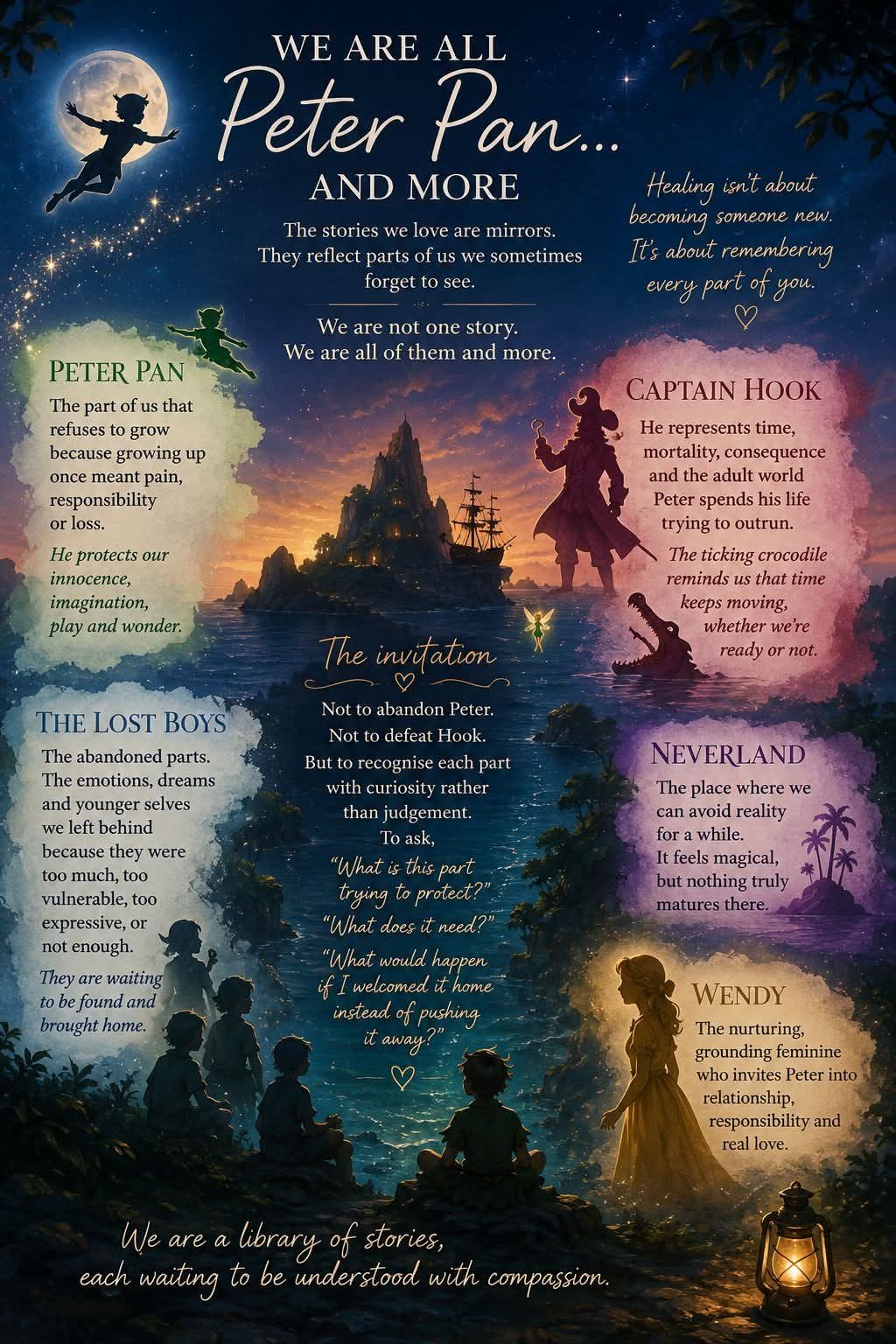
Today's reflection whilst on the treadmill at gym. Thanks Bub.
The other evening, Will looked up from watching Peter Pan and asked me, “Do you know what Peter Pan syndrome is?”
I laughed so hard I cried. Not because I was laughing at him, but because of the innocence with which the question was asked. He then looked at me quite seriously and said, “Why did you assume I was talking about myself?”
It was one of those beautiful moments that life occasionally offers—where laughter gives way to something much deeper.
As we talked, he asked did I know Peter, Hook and the other characters were all the same person. I paused before replying. “I think we are all of them,” I said. “And more.”
That conversation stayed with me long after the movie had finished. Perhaps this is why stories endure across generations. They are rarely just stories. They are mirrors. Archetypes. Reflections of the human experience.
Peter Pan is often described as the boy who never wanted to grow up. But what if Peter isn't simply immature? What if he is the part of us that learned, long ago, that growing up meant losing something precious?
Perhaps Peter appears every time we avoid grief. Every time we distract ourselves instead of feeling. And yet Peter also reminds us of imagination, wonder, creativity and play. Without him, life can become rigid and joyless.
Then there is Captain Hook. Often seen as the villain, Hook may simply represent everything Peter fears—time, responsibility, consequence, ageing and mortality. How many of us spend our lives trying to outrun that ticking clock?
And then there are the Lost Boys. When I was asked who they were, the answer arrived almost before I had time to think. “They are the abandoned parts.” The parts of ourselves we left behind because they were too vulnerable, too frightened, too joyful, too expressive, too much… or not enough.
The child who stopped singing. The teenager who learned not to cry. The adult who forgot how to rest. The dreamer who buried their dreams beneath responsibility.
Perhaps healing isn't about becoming someone new. Perhaps healing is about gathering the Lost Boys and Lost Girls within us and gently bringing them home.
This is why I love archetypes. Not because they place us in boxes, but because they remind us that no single character defines us. There are moments when we are Peter. Moments when we are Hook. Moments when we are Wendy, nurturing everyone except ourselves.
We move between them throughout our lives. None of them are who we are. They are simply parts of the rich landscape of being human.
The invitation is not to reject Peter. Nor is it to defeat Hook. It is to recognise each part with curiosity rather than judgement. To ask, “What is this part trying to protect? What does it need? What would happen if I welcomed it home instead of pushing it away?”
Perhaps that is what returning to ourselves truly means. Not fixing. Not perfecting. Not becoming. Remembering. Because we are not one story. We are a library of stories. And every part of us is waiting, not to be judged, but to be understood with compassion.
Maybe that is what all great stories have been trying to tell us all along.